

Think about your last few happy customers - the ones who thanked you, shook your hand, or sent a follow-up email saying how great the experience was. Now check your Google Business Profile. Odds are, most of them never left a review.
That's not because they weren't satisfied. It's because nobody asked.
Enter one of the biggest missed opportunities we see in marketing. Business owners pour their time and money into delivering great work, but when it comes to turning that goodwill into visible, public proof, there's a gap. And that gap is costing them visibility, trust, and new customers every single day.
The tricky part? Most business owners know reviews matter. They just don't know how to get more Google reviews without feeling pushy or accidentally overstepping policies. So they do nothing, and their competitors - the ones who figured out a system - keep pulling ahead.
In this guide, we're breaking down everything you need to know: why Google reviews deserve a top spot in your marketing strategy, how to ask for them in a way that feels natural (while staying within the rules), and how to build an online reputation management process that keeps reviews flowing.
Why Google Reviews Matter More Than Ever

If you're treating Google reviews as a "nice to have," it's time to rethink that. More than just social proof, they're one of the most accessible ranking signals you can actually influence, and their impact reaches further than most business owners realize.
They directly affect where you show up in local search
When someone searches for a service, Google decides which businesses appear in local search, specifically the Map Pack: the top three local results bundled with a Google Map. These get the lion's share of clicks, and reviews are a major part of that decision.
Google's local algorithm weighs review quantity, quality, recency, and how often you respond. A business with a steady stream of recent reviews has an appreciable advantage over one sitting on a handful of ratings from two years ago. In other words, why Google reviews matter for your business isn't a theoretical question, but a measurable one.
They shape how customers decide who to call
The majority of consumers read Google reviews before choosing a local business, with the majority paying close attention to the recency of those reviews. A 5-star rating based on a few reviews from 2022 doesn't carry the same weight as a 4-star rating based on dozens of reviews from the past few months.
And here's something that surprises a lot of business owners: a perfect score can actually work against you. A mix of mostly positive reviews with the occasional critical one reads as more authentic than a spotless record. People aren't looking for perfection here - they're looking for honesty.
They move people from "maybe" to "yes"
Besides driving traffic to your listing, reviews reduce the space between interest and action. When a potential customer is comparing two or three businesses side by side, detailed reviews from real people tip the scale in a way that no amount of self-promotion can.
They function as third-party endorsements that your own marketing simply can't replicate. In this case, a well-reviewed business converts more of the attention it earns.
They're starting to shape how AI describes your business
Google is increasingly using review content to generate AI-powered summaries - the blurbs that appear in AI Overviews, business profile descriptions, and other AI-driven search features. When a customer writes a detailed review mentioning specific services, locations, or experiences, that language could directly influence how Google's AI summarizes and presents your business to future searchers.
What your customers say about you doesn't just affect whether you show up anymore; it shapes how you show up.
What Google Allows (And What It Doesn't)
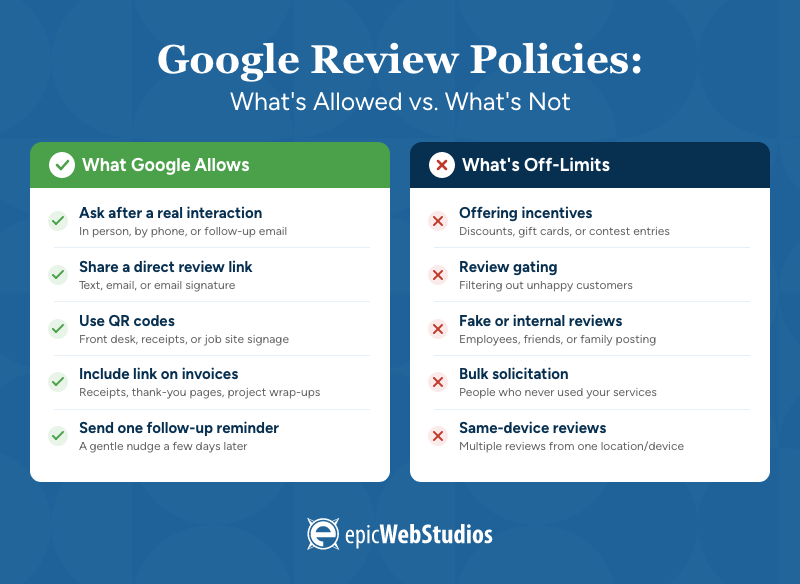
Before we get into tactics, let's clear something up: Google explicitly encourages businesses to ask customers for reviews. This isn't a loophole or a gray area – it's right there in their official guidelines. The problem is that some businesses are asking the wrong way.
What's off-limits
Google draws hard lines around anything that compromises the authenticity of a review. That includes offering incentives (i.e., discounts, free products, gift cards, contest entries) in exchange for someone leaving a review. It doesn't matter if you're asking for an "honest" review rather than a positive one. If there's a reward attached, it's still a policy violation.
Review gating is another big one. That's when a business sends customers to an internal feedback form first, and only routes the happy ones to Google while quietly filtering out the rest. Google considers this a form of manipulation, and it can result in reviews being removed or your profile being flagged.
Other violations include things like:
- Having employees, friends, or family post reviews
- Soliciting reviews in bulk from people who never actually did business with you
- Posting reviews from the same device or location
Note that Google's spam detection has gotten significantly more sophisticated, so these tactics carry real risk.
What's perfectly fine
Asking a customer to leave a review after a genuine interaction - whether that's in person, over the phone, or through a follow-up email - is not only allowed, it's encouraged. For instance, you could:
- Send a text or email with a direct link to your Google review page
- Display a QR code at your front desk, on a receipt, or on a job site sign
- Include your review link in your email signature, on invoices, or on a thank-you page after a completed service
The key is that the ask is tied to a real customer experience, it's made without conditions, and the customer has full freedom to say whatever they want (or nothing at all).
Why this matters beyond just "following the rules"
The consequence of violating Google's review policies isn't just a slap on the wrist. It can lead to individual reviews being pulled, a wave of reviews getting wiped overnight, or, in serious cases, suspension of your GBP entirely.
We've seen businesses lose months or even years of built-up reviews because of shortcuts that seemed harmless at the time. In the end, the ethical approach is the only strategy that truly holds up.
How To Ask Customers For Reviews
The reason most businesses don't have more reviews isn't that their customers are unwilling. It's that the ask either never happens, or it happens in a way that feels stiff, transactional, or poorly timed.
The good news is that it doesn't take a perfect script. Instead, you're looking for the right moment with a genuine tone and a little bit of consistency.
Ask when the experience is still fresh
Timing makes or breaks a review request. The best window is right at the peak of a customer's positive experience - immediately after a project wraps up, a problem gets resolved, or a service is completed. That's when the goodwill is highest, and the details are still vivid enough to write about.
Wait a week or two, and you're fighting against the natural fade of enthusiasm. They might still feel good about the experience, but they're far less likely to sit down and put it into words.
Make it personal
A generic "Please leave us a review!" gets ignored. On the flip side, a message that uses their name and references something specific about their experience gets results.
The goal here is for the request to feel like a real human interaction, not a marketing blast. People are more willing to do something small for a business that makes them feel seen.
Ex: Hey Sarah, we're glad the new patio turned out the way you envisioned. If you have a minute, we'd really appreciate a quick Google review!
Keep it low-pressure
The framing matters more than most people think! When you position a review request as optional and appreciated rather than expected, it removes the awkwardness for both sides.
This works because it gives the customer an easy out if they're not up for it, while still making the ask clear. Nobody wants to feel like they owe you something.
Ex: If you get a chance, we'd love to hear your feedback.
Get your whole team on the same page
The person best positioned to ask for a review is usually the one closest to the customer at the moment things go well - and that's not always the business owner or the marketing team. It might be a technician finishing a job, a front desk person wrapping up an appointment, or an account manager closing out a project.
If your team doesn't know that asking for reviews is part of the workflow, it won't happen consistently. Luckily, a quick internal conversation about when and how to ask goes a long way.
Follow up once
Sometimes people fully intend to leave a review and just forget. A single follow-up a few days later (i.e., a quick email or text) is completely reasonable and often effective.
But remember: there's a hard line between a gentle nudge and nagging. If someone doesn't respond after one reminder, let it go. Bombarding customers with repeated requests does more damage to the relationship than the review is worth.
Make It Easy To Leave A Review
You can nail the timing, personalize the ask, and say all the right things - but if leaving a review requires your customer to figure out where to click, most of them won't bother.
Set up your Google review link
Every GBP has a shareable link that takes customers straight to the review form with no searching or extra clicks. If you haven't generated yours yet, you can find it in your GBP dashboard under the "Ask for reviews" section.
Google will provide you with a shortened link you can copy and use anywhere. This is very important; one small step eliminates the most common reason people abandon the process halfway through.
Turn it into a QR code
For any business with a physical location or in-person interaction, a QR code is one of the easiest ways to bridge the gap between a great experience and a published review. Print it on a card that sits at the front desk, add it to the bottom of receipts, or put it on a small sign near checkout.
Customers can scan it with their phone in seconds while the experience is still top of mind. It's low-effort for them and costs you almost nothing to set up.
Put the link everywhere your customers already look
To be the most effective, your review link shouldn't live in one place. You want it to show up across every natural touchpoint in your customer journey. A few examples:
- Add it to your email signature so every message you send is a passive reminder
- Include it in post-service follow-up emails and on invoices/receipts
- Put it on your website's footer
- Send it out via thank-you emails or project wrap-up summaries
The goal isn't to be aggressive about it. You're just looking to make sure that when a customer decides they want to leave a review, the path to doing so is already right in front of them. Remove the guesswork, and you'll be surprised how many more people follow through!
How To Respond To Google Reviews
Getting reviews is only half the equation. How you respond to them (and whether you respond at all) sends a signal to both Google and every potential customer who reads your profile.
Businesses that consistently engage with their reviews build more trust, encourage more feedback, and tend to perform better in local search.
Respond to the positive ones, too
Most business owners understand the importance of addressing a bad review. Fewer realize that responding to positive reviews matters just as much.
When someone takes the time to say something nice about your business, acknowledging it does a few things at once: it reinforces that customer's good experience, shows future customers you're attentive, and creates the kind of visible engagement that encourages other people to leave their own reviews.
A good response to a positive review is specific and genuine without being overly lengthy. Use their name while referencing something about the work performed or the experience. And as you go about responding, try to keep the tone conversational.
Ex: Thanks, Sarah! We loved working on your kitchen remodel, and we're glad you're happy with how the tile turned out.
Handle the negative ones with composure
Bad reviews happen to every business, so how you respond matters far more than the review itself. A potential customer reading your profile will absolutely judge you based on how you handle criticism. You're not here to win the argument; you need to demonstrate that you take feedback seriously and treat people with respect, even when the situation is frustrating.
Although it may be difficult at times, keep it as calm and professional as possible. Begin by acknowledging what the customer experienced without getting defensive, then offer to continue the conversation offline if there's something to resolve. In many cases, a thoughtful response to a negative review actually builds more credibility than the review takes away.
Ex: We're sorry this didn't meet your expectations - we'd like to work with you to make it right. Please reach out to our team directly at [contact info].
What to avoid
A few things that consistently do more harm than good:
- Copy-pasting the same generic reply across every review
- Getting into a back-and-forth argument in the comments
- Being defensive or dismissive
- Using your response as a thinly veiled sales pitch
Your review responses are a public-facing reflection of how you treat people. Keep them human, keep them brief, and keep them focused on the customer - not on you.
Build A Review Strategy That Sustains Itself
Everything we've covered so far works if it happens consistently. The businesses that maintain a strong review presence aren't running one-off campaigns or riding a burst of motivation that fades after a few weeks. They've built a system that turns review generation into a background process, something that runs alongside the work they're already doing without requiring constant attention.
That's the difference between a handful of reviews and an online reputation management strategy that compounds over time.
Systematize the ask
If getting reviews depends on someone remembering to ask, it's going to be inconsistent. The most reliable approach? Bake review requests into the workflows you already have.
That could mean adding a review request step post-service, including a link in your standard project email template, or adding it as a line item on your team's job completion checklist.
The specifics will look different depending on your business, but the principle is the same: make asking for reviews a default part of your process, not something that relies on individual initiative.
Keep an eye on what's coming in
A review strategy without monitoring is like running ads without checking the results. Set up notifications through your GBP so you know when new reviews land, and make a habit of checking in regularly. Prompt responses (especially to negative reviews) show that you're paying attention.
But monitoring isn't only about reputation management in the moment. Over time, patterns in your reviews can surface real operational insights. If three different customers mention long wait times or a confusing checkout process, that's not just a review problem - it's a business problem worth fixing.
Don't put all your eggs in Google's basket
Google should be your primary focus, as it's where the majority of consumers look first and where reviews have the most direct impact on local search visibility. But a business that has reviews on Google alone and nowhere else can come across as one-dimensional.
Encourage reviews on Facebook, Yelp, and any industry-specific platforms that matter in your space. A broader review presence reinforces your credibility, giving potential customers multiple places to validate their decision. It also protects you, because if something ever goes sideways with your Google profile, you've still got social proof elsewhere.
Track the numbers that actually tell you something
Four metrics are worth paying attention to:
- Total review count
- Average star rating
- Recency of your latest reviews
- Business owner response rate
Together, these paint a clear picture of your review health and directly influence how Google evaluates your business.
A high rating with no recent reviews signals a stale profile, while a growing review count with no responses signals a business that isn't engaged. Track these regularly, even informally, and you'll have a much better sense of where you stand vs. what needs attention.
Put Your Best Reviews Forward With Epic Web
You don't need gimmicks to get more Google reviews - just a great experience, a simple system, and the consistency to keep it running. Because the truth is that the businesses pulling ahead in local search aren't doing anything complicated. They're merely treating online reputation management as the long-term asset that it is.
Not sure where to start? From local search engine optimization (SEO) to reputation strategy, Epic Web Studios helps businesses turn customers into visible, lasting social proof.
