
The "blue link" is no longer the destination.
For the last twenty years, the ritual of the web was consistent: you went to Google, typed a query, and sifted through a list of websites until you found what you needed. But as we move into 2026, that ritual is fading. Today, we don't search for information; we retrieve answers.
The shift from search engines to answer engines (like Perplexity, ChatGPT, and Google's AI Mode) has fundamentally rewired the digital landscape. Across the industry, we are seeing organic clicks drop by an average of 20% as AI Overviews satisfy user intent directly on the results page.
This "zero-click" phenomenon might sound like a crisis for businesses, but there is a silver lining: conversion quality is at an all-time high. When a user does click through to your site, they aren't just browsing. Instead, they have already been primed by an AI agent (an autonomous bot acting on a user's behalf) that cited your brand as the authority. They arrive more qualified, better informed, and closer to a purchase than ever before.
Your Website as a Data Source for Agentic AI Systems
In the past, your website was a digital storefront. You polished the windows, put up pretty signs, and hoped people would walk in. But in 2026, your website has a dual purpose. It still has to look great for people, but it also has to serve as a highly efficient data source for AI agents.
Think of these AI models as the personal concierges for your customers. As these systems begin to handle everything from planning family vacations to managing complex businesses-to-business (B2B) buying, they read your site differently than a human does.
While your customers are looking at your beautiful photos or catchy headlines, the AI is looking "under the hood" to decide if you are the best choice to recommend, including:
- Schema: This is the invisible code that tells the AI exactly what your data means. With it, the AI can confidently say, "Here is the best price for this specific service."
- Technical Layout: AI favors sites that are structured logically and load quickly. If an agent gets lost in your site's code, it will simply move on to your competitor.
- Topical Authority: The AI checks to see if you are a true expert. It looks for a deep library of content that demonstrates an in-depth understanding of your industry.
Navigating the future of web search requires more than just the Search Engine Optimization (SEO) tactics of yesteryear. Simply put, you can't just sprinkle keywords on a page and hope for the best. Success today requires a high-wire balancing act: you need a human experience that converts real people, and machine readability that wins over AI agents.
The Rise of GEO (Generative Engine Optimization)
If a user gets their answer without ever clicking on a website, how does your business win? The answer is Generative Engine Optimization (GEO). To succeed today, your brand must be the expert source that the AI chooses to credit and recommend.
If your brand isn't mentioned in that response, you don't exist to that user. That's why optimizing for clicks alone won't work anymore; citations are what organizations need to be focusing on moving forward.
From Backlinks to Brand Mentions
For decades, backlinks (other sites linking to yours) were a cornerstone of SEO strategy. While those still matter, AI models like ChatGPT prioritize brand mentions in addition to topical authority and relevance.
AI scans the entire web to see who is considered an expert. It asks: Is this brand mentioned in industry forums? Are their experts quoted in news articles? Does their own site cover every angle of this topic? The endgame is to build a digital reputation that forces AI to recognize you as the definitive thought leader.
Model Context Protocol
Model Context Protocol (MCP) is the new universal standard for how AI agents talk to your website. Previously, AI had to "scrape" your site like a human reading a book. With MCP, we now have a direct line of communication. This allows AI agents to:
- Interact directly with your real-time data (like inventory or pricing).
- Understand your services with 100% accuracy.
- Recommend your business without any technical friction of understanding your site.
For the AI agent to recommend you, it must find exactly what it needs when it parses your data. Otherwise, you will ultimately be skipped over for a competitor who made their information easier to digest.
Adaptive User Interface: Designing for the Future of Web Search

Web design used to follow the simple rule of making everything look good for consumers. But in 2026, a "pretty" website is no longer enough. If your site is only built for human eyes, these AI agents will get stuck, and you'll lose the sale before a person ever sees your homepage.
What is an Adaptive User Interface (AUI)?
An AUI is a website that reconfigures itself in real-time based on who (or what) is visiting. For a human, the site focuses on emotion, brand story, and visual ease, effectively guiding the user to a solution. By analyzing real-time user intent, the most relevant information can be moved to the top, call-to-action (CTA) buttons changed, or navigation simplified based on the visitor's past behavior.
For an AI agent, the site shifts into a high-efficiency data mode. It presents the machine experience (MX) first, offering clear data points that an agent can verify and act upon in milliseconds.
The challenge for businesses today is balancing beauty with brains. You need a site that is visually stunning enough to build brand trust, but has the functional intelligence to be useful in an AI-mediated world.
|
Feature |
Traditional Web Design |
Adaptive UI |
|
Focus |
Visual Aesthetics |
User and agent data |
|
Content |
Static text and images |
Dynamic, personalized data |
|
Navigation |
Fixed menus |
Fluid, AI-guided journeys |
|
Goal |
Keep the user browsing |
Solve the problem quickly |
The Agency Gap: Why You Can't Automate Strategy
Recent industry data shows a staggering reality, with up to 80% of AI projects failing to deliver a measurable return on investment (ROI). The reason? Most businesses treat AI as a plug-and-play tool, but without a human strategy to guide it, these projects quickly become a financial drain rather than a strategic asset. The missing link is almost always human-AI communication.
E-E-A-T Foundation
While AI is incredible at summarizing existing facts, it has a glaring weakness: it cannot replicate human experience. This is why optimizing for E-E-A-T (Experience, Expertise, Authoritativeness, and Trustworthiness) is the centerpiece of a strong strategy for the future of web search.
For example, AI can describe how a product works, but it can't tell a story about the time a consultant stayed up until 2 AM to help a client hit a deadline. It can't offer a unique point of view based on twenty years in the field.
Our agency provides the experience that AI lacks. By incorporating your unique human insights, first-hand case studies, and expert opinions into your digital presence, we ensure that:
- Search engines recognize you as a trusted entity worth ranking.
- AI engines cite you as the authoritative source.
- Human customers feel a connection to your brand that a bot simply cannot forge.
In an automated world, humanity is your greatest competitive advantage. Our role is to make sure the machines know it!
New KPIs for 2026
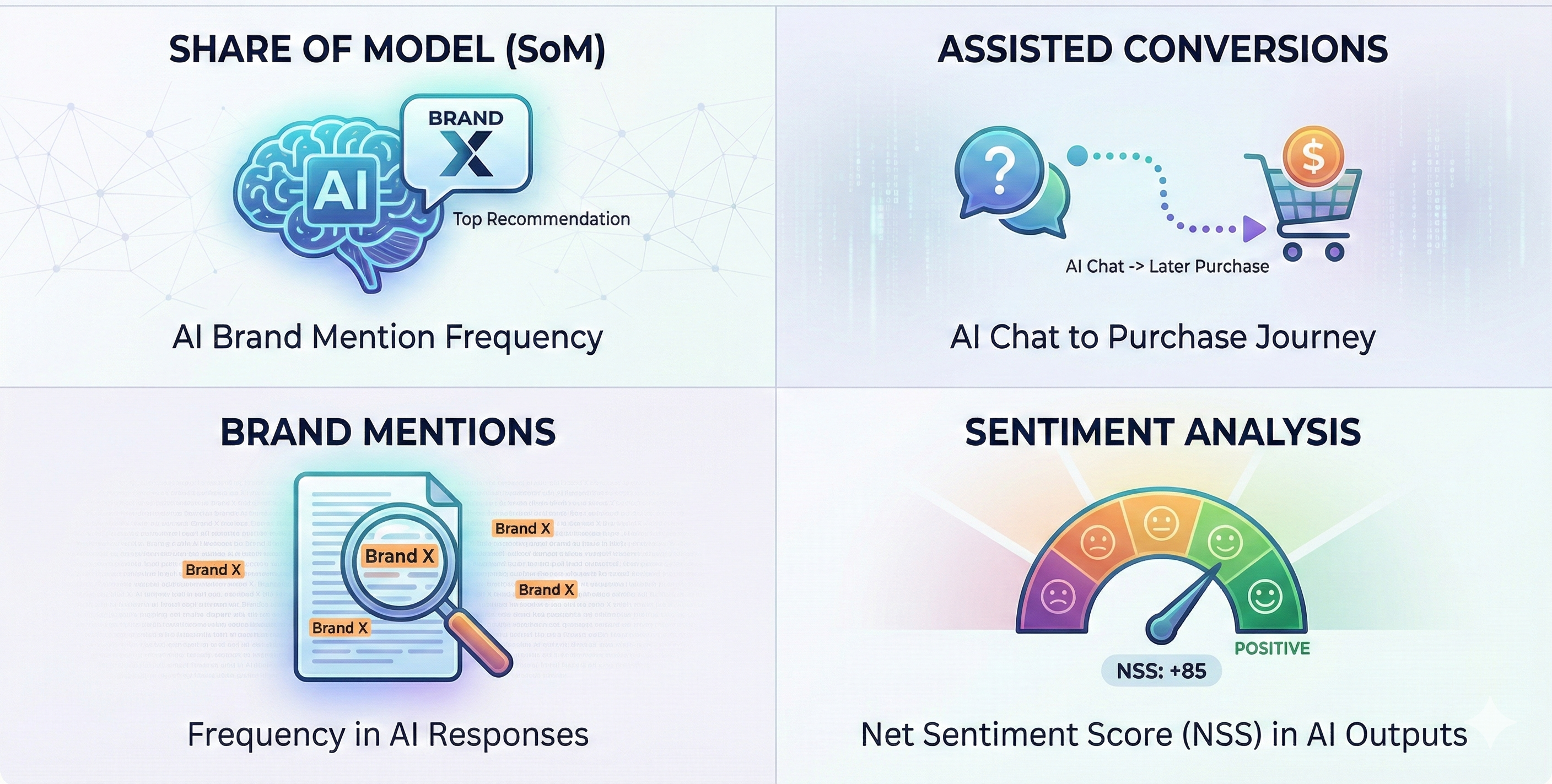
As we transition to GEO, the metrics we use to define success must also receive an upgrade. To be the primary citation in an AI-generated answer, it's time to say goodbye to vanity metrics (raw rankings) and hello to impact metrics (influence and sentiment).
|
Traditional SEO Metric |
GEO Metric |
Why It Matters |
|
Keyword Rankings |
Share of Model (SoM) |
It's not about being #1 on a list, but how often an AI mentions your brand when asked a relevant query. |
|
Click-Through Rate (CTR) |
Assisted Conversions |
Users may get their answer directly in the AI chat. If they click, they are high-intent. If they don't, the AI assists the eventual conversion elsewhere. |
|
Backlinks |
Brand Mentions and Citations |
AI prioritizes "entity authority." Unlinked mentions in high-trust sources now validate your brand as much as hyperlinks. |
|
Bounce Rate |
Sentiment Analysis |
If an AI summarizes your reviews negatively, you lose the recommendation before the user ever visits your site. |
Brand Mentions
This key performance indicator (KPI) measures the frequency with which your brand appears in AI-generated responses for your target topics. You want to be the default entity the AI associates with a specific solution (i.e., when a user asks "best marketing agency for small business," the AI automatically lists you).
To start tracking brand mentions, monitor the frequency of your brand name appearing in AI overviews across a set of 50-100 informational queries.
Sentiment Analysis in AI Answers
AI models digest thousands of reviews and forum discussions to generate a consensus on your product.
Say, for instance, that your Trustpilot score is low. In this case, the AI may proactively warn users by answering with, "While Brand X offers cheap rates, users frequently report billing errors."
The metric to keep an eye on is your Net Sentiment Score (NSS) within AI outputs. Are you being cited as a top recommendation, a budget alternative, or a risk?
Assisted Conversions and Zero-Click Search Strategy
A user might chat with ChatGPT for 20 minutes about car safety features, decide on your brand, and then visit your site directly three days later to buy. Essentially, we must stop expecting every interaction to result in an immediate click.
The next step is to track assisted conversions using the latest Google Analytics and other analytics platforms. Look for an increase in direct and brand search traffic that correlates with your GEO efforts.
At the same time, it's important to recognize that while total traffic volume may drop (due to zero-click answers), the quality of traffic will increase. Users clicking through from an AI summary are already educated and ready to convert.
Embrace the Future of Web Search with Epic Web Studios
Success in 2026 is about being understood by the machines that curate the world's information. If an LLM crawled your site today, would it clearly understand your value proposition, or would it brush over your services?
Don't leave your business's reputation to chance! The team here at Epic Web can thoroughly review your digital footprint. We will analyze your cross-platform presence and test your site's readability, so the next time a user question is posed, AI cites you as the answer.
